.jpg)


Ongaonga: Heritage, Central Hawke’s Bay; bonus route map
- Sarah-Jane Lee
- 15 hours ago
- 4 min read

"Village of the Past"
Rolling hills and the preserved timber of Ongaonga offer a different kind of recalibration. Here is a holiday reboot; a time capsule, effectively frozen since the 1890s. The village proves 'Slow Travel' isn't just a trend; it’s a biological necessity. Whether you’re standing in the cypress-scent of the Coles Factory or peering into the Broom Hut, you’re recalibrating your sense of time and place. Quietly breathe in the history, and let the 1890s soak into your soul.
📍 Node 1: The Ongaonga Historical Society & General Store
Your mission begins at the heart of the village. The Ongaonga General Store is not a functioning retail unit in the modern sense; it is a meticulously maintained archive of Edwardian life.
The Data: Step inside to find shelves stocked with period-correct hardware, vintage packaging, and primary source documents from the town's peak.
The Logic: Radical Transparency. This museum doesn't just show you "old stuff"; it shows you the Hardware Logic of early NZ life. You are shown how people archived their food, their tools, and their social connections before the digital overwrite.
Savvy Tip: Look for the local school records and photographs in the Ongaonga Settler Museum. They provide a high-resolution look at the human variable in rural Hawke’s Bay across three centuries.
📍 Node 2: Coles Factory
The Industrial Archive. If your mission is 'Architectural Fidelity,' the Coles Factory is your primary target. Built in 1878, this historic joinery and sash-and-door factory stands as a high-resolution masterpiece of Victorian industrial hardware. NZJANE acknowledges the radical dedication of the local Historical Society in maintaining this outstanding gem; their work ensures this vital piece of NZ history remains archived exactly where it belongs, nestled in the heart of the countryside."
Sensory ROI: The scent of aged sawdust and native timber is a potent sensory reboot. The factory still houses original machinery that helped build the houses you see in the village today.
The Mission: It is a rare closed-loop system where the tools used to build the town are still archived within the town itself.
📍 Node 3: The W.C. Ross Butcher & Architectural Walk
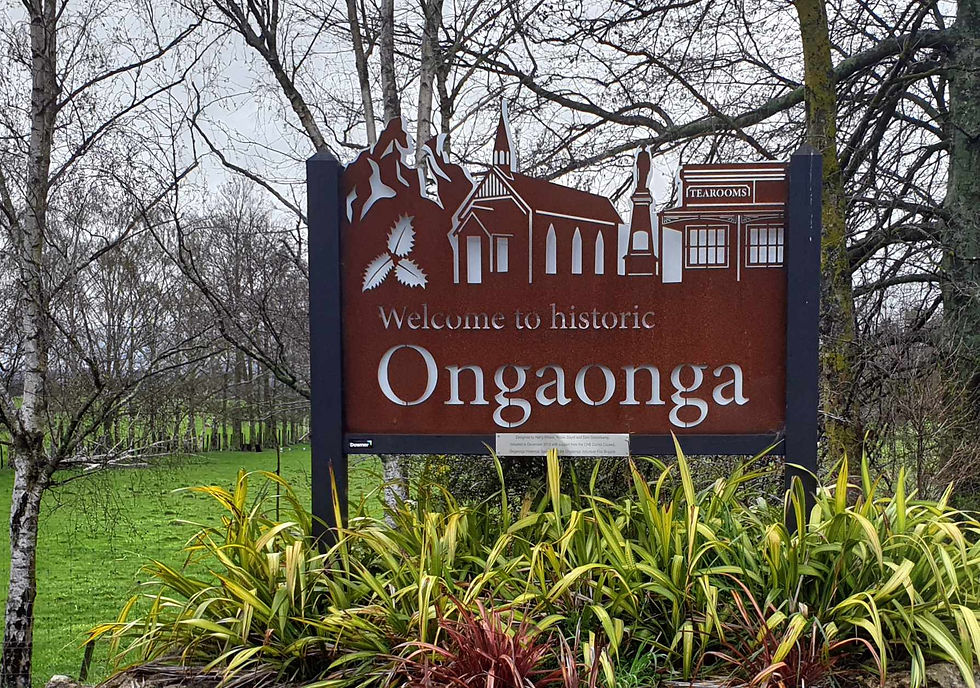
Ongaonga is often called "The Pink Village" due to the distinctive colour palettes of its historic buildings. The visual data here is at 100% purity.
The W.C. Ross Butcher Shop: This "wee dinky" building is a primary source for 19th-century retail architecture. The late architect Michael Fowler famously noted this as one of the best architectural buildings in Hawke’s Bay.
The Detail: Observe the intricate timber detailing and the functional white shutters. Outside stands a vibrant red vintage petrol bowser, acting as the bridge between the "Horse and Cart" era and the early internal combustion vehicles.
The Architecture Walk: Practice the "Mobile in Pocket" protocol. Walk the main street and observe the "Gothic Revival" flourish. While most tourists flock to Napier for Art Deco (1930s), the savvy researcher heads here for the pre-1900s archive.
📍 Node 4: The Agricultural Open Air Museum & Broom Hut
Just a short walk along the main street, this outdoor node is dedicated to the Hardware of the Land.
The 1950s High Country Hut (Broom Hut): This is a primary source for "Backcountry Logic." Originally an ex-Forest Service "Broom Hut" from the rugged Ruahine Ranges, this orange-clad shelter is a high-fidelity time capsule.
The Sensory Data: Peer through the window to see the "eerie fidelity" of a mannequin asleep on the bunk. It is a small, wooden archive of 1950s tramping culture; functional minimalism at its peak.
Machinery Archive: Surrounding the hut is a collection of vintage tractors and farm implements, representing the era of manual "System Overwrites" before the digital farming age.
Transitioning to 'Historian' mode now. #OngaongaArchive #CentralHawkesBay #SavvyHeritage"
GETTING TO ONGAONGA
This isn't a place you just "end up" in; it’s a deliberate destination that requires a transition from the high-speed main highways to the low-frequency provincial backroads.
Option A: Scenic Route (via SH50)
If you are coming from the North (Napier/Hastings), skip the SH2 "Mainframe." Instead, take State Highway 50.
The Logic: This road runs along the base of the Ruahine Ranges. It is a higher-resolution visual experience with less heavy-vehicle noise.
The Turn-off: Look for the Ongaonga-Waipukurau Road intersection. It leads you directly into the heart of the "Pink Village."
Option B: Mainline (via SH2)
If you are traveling from the South (Dannevirke/Woodville) or need to refuel in the larger hubs first.
The Logic: Follow State Highway 2 to Waipawa.
The Transition: Turn onto Tikokino Road/Ongaonga Road. This 15-minute stretch acts as a "Decompression Chamber," transitioning you from the busy highway to the quiet rural archive.
Ongaonga is located approximately 20km west of Waipawa.
📊 Savvy Snapshot: Travel Variables
From Node | Distance | Time ROI | Jay’s Logic (The Savvy Tip) |
Napier / Hastings | 65–70 km | ~55 mins | Take SH50. The "Atmospheric Perspective" of the ranges is worth the extra 5 minutes. |
Waipawa | 15 km | ~12 mins | Perfect for a quick "Hardware Refuel" (coffee/supplies) before the mission. |
Dannevirke | 55 km | ~45 mins | A straightforward run up SH2. Watch for the "Settlement Signs" near Takapau. |


